
When the Renters’ Rights Act was first announced, many landlords reacted with a mixture of frustration and concern.
To be fair, it’s easy to see why.
The abolition of Section 21, tighter regulations, additional compliance requirements, and greater tenant protections have all been presented as reasons why landlords should be worried.
And whilst some landlords are looking at their portfolios and wondering whether it’s time to exit the market, I think another question needs asking:
If landlords are leaving, who benefits?
Sometimes the best opportunities appear when everybody else is focusing on the negatives.
A Quick Reminder of What’s Changed
The new legislation has introduced some significant changes to the private rented sector, including:
- The end of Section 21 “no fault” evictions.
- The replacement of fixed-term ASTs with rolling periodic tenancies.
- Greater rights for tenants to challenge rent increases.
- A ban on rental bidding wars.
- New landlord registration and ombudsman requirements.
- Stronger property quality standards.
- Increased protections for families, benefit recipients and pet owners.
There is no doubt that the role of a landlord is becoming more professional.
For some investors, that will be a problem.
For others, it could be an opportunity.
What The Market Is Telling Us
A recent property market update from Phil Spencer caught my attention because the numbers paint a very interesting picture.
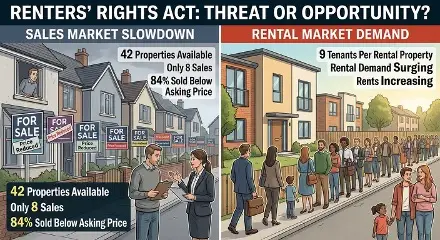
The Sales Market
 Average estate agent stock: 42 properties
 Average completed sales: 8 properties
Only 9% of sales were agreed above asking price
84% of sales completed below asking price
Visual Snapshot
Properties Available ████████████████████████████████████ 42
Properties Sold ████████ 8
The message is fairly clear.
Buyers currently have more choice.
Sellers are competing harder than they have for some time.
Negotiating power has shifted towards purchasers.
Many vendors are having to accept offers below asking price just to get deals moving.
But The Rental Market Is Telling A Different Story
This is where things become interesting.
Whilst sellers are competing for buyers, tenants are competing for properties.
Current figures suggest there are around:
9 Tenants For Every Available Rental Property
 Available Property

9 prospective tenants
That level of demand creates something landlords have always wanted:
- Low void periods
- Consistent tenant demand
- Strong rental income
- Reduced vacancy risk
And despite all the discussion around the Renters’ Rights Act, none of those fundamentals have changed.
In fact, some could argue they’ve become stronger.
The Unintended Consequence
Whenever governments introduce additional regulation, there are usually unintended consequences.
Some landlords decide they’ve had enough.
Some sell.
Some retire.
Some simply don’t want to deal with increased compliance.
That’s their choice.
But if enough landlords leave the sector, we end up with fewer rental properties available.
And when supply falls whilst demand remains high, rents tend to rise.
We’re already seeing evidence of that across many areas.
Which brings me back to my original question.
Who Actually Benefits?
Professional Landlords
The investors most likely to benefit are those who:
 Already understand the sector
Have well-maintained properties
Are comfortable with regulatory requirements
Have access to funding when opportunities arise
Whilst others are exiting, experienced investors may find themselves able to acquire properties at discounted prices in a market where tenant demand remains exceptionally strong.
Investors With Finance Ready To Go
One statistic stands out above all others.
84% of sales are reportedly completing below asking price.
That creates opportunities.
The investor who already has funding agreed is often in a much stronger position than someone who starts looking at finance after finding a property.
This is where products such as:
- Buy-to-let mortgages
- Limited company buy-to-let facilities
- Bridging finance
- Auction finance
- Portfolio refinance solutions
can become valuable tools.
Property Developers
Developers may also have more options than they’ve had for years.
If sales prices come under pressure, some schemes could become more attractive as:
- Build-to-rent developments
- Long-term investment assets
- Income-generating portfolio additions
Rather than relying solely on sales, developers have another exit strategy available.
Not Everyone Wins
I also think it’s important to recognise who may find the market more challenging.
Homeowners Looking To Sell
With buyers holding stronger negotiating positions, sellers may face:
- Longer marketing periods
- More price reductions
- Greater scrutiny from purchasers
- Increased competition
First-Time Buyers
Whilst there may be more room to negotiate on purchase price, many first-time buyers still face the same challenges:
- Deposit requirements
- Affordability tests
- Rising living costs
- High rental payments making it difficult to save
My Take
The media narrative around the Renters’ Rights Act has largely focused on what landlords are losing.
I think that’s only half the story.
Yes, landlords face more regulation.
Yes, compliance has become more important.
Yes, there are additional responsibilities.
But at the same time we’re seeing:
Strong rental demand
Rising rents
Buyers able to negotiate discounts
Potentially fewer landlords competing for acquisitions
For investors with capital, experience, and access to finance, this may not be a market to fear.
It may be a market to take advantage of.
As always, the opportunities tend to favour those who are prepared.
Darren Butcher
Director | BAT Financial Solutions Ltd
Helping property investors, developers and business owners access the funding they need to grow.
“When others see problems, experienced investors often see opportunity.”